Floater motion sensor
The
Floater motion sensor can be added by clicking on the sensor icon in the floater part, as shown in the picture below
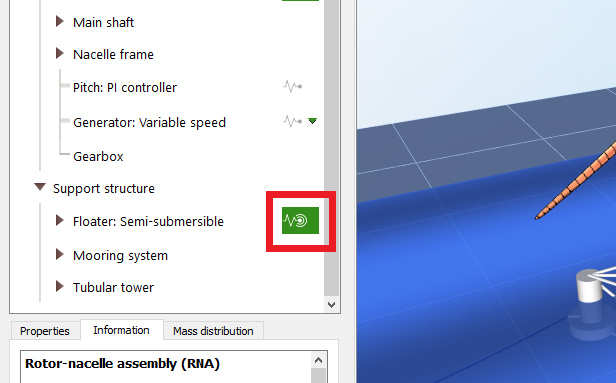
The
Floater motion sensor provides the following fields
| Field | Unit | Description |
| Surge (forward) | m | Translation of the reference node along the surge (forward) axis |
| Sway (sideways) | m | Translation of the reference node along the sway (sideways) axis |
| Heave (up) | m | Translation of the reference node along the heave (vertical, upward) axis |
| Roll (about surge axis) | deg | Rotation of the reference node about the surge (forward) axis (roll) |
| Pitch (about sway axis) | deg | Rotation of the reference node about the sway (sideways) axis (pitch) |
| Yaw (about heave (vertical) axis) | deg | Rotation of the reference node about the heave (vertical) axis (yaw) |
| Draft | m | Length of the floater centre line that is currently below the water surface, measured from the lowest node of the floater. This field is only available if the model contains a Sea part |
| Yaw error (relative to wind angle) | deg | Angle between the wind direction and the forward direction of the floater |
How the fields are computed
The rigid body motion of the floater is not an average over the nodes of the floater. It is read from a
single reference node: the
highest node of the floater, that is the node of the floater with the largest initial vertical coordinate. For a spar buoy or a semi-submersible, this is the node at the top of the floater, where the tower is connected. All six motion fields (surge, sway, heave, roll, pitch and yaw) describe the motion of that node.
Translations
Surge, sway and heave are the components of the displacement vector of the reference node, that is its current position minus its initial position. They are therefore
relative to the initial position of the floater and all start at zero, and they are not absolute coordinates: a floater whose top node sits 10 m above the mean sea level at the beginning of the simulation reports a heave of 0 m at that instant, not 10 m.
Rotations
Roll, pitch and yaw are the components of the
rotation pseudo-vector of the same reference node, obtained from the finite rotation tensor of that node and projected onto the surge, sway and heave axes. For the moderate rotations expected of a floating wind turbine these components can be read as roll, pitch and yaw angles. Note however that, because they are the components of a single rotation vector and not a sequence of Euler angles, they should be interpreted with care if the floater undergoes large rotations about several axes at once.
Axes
The heave axis is always the vertical axis of the
Global Coordinate System (pointing up).
The surge and sway axes are horizontal and they
follow the floater: they are the forward and sideways axes of the floater in its current, displaced configuration, projected onto the horizontal plane. The displaced orientation of the floater is taken from the finite rotation of the
lowest node of the floater. In the undisplaced configuration, the surge (forward) axis is aligned with the global y axis (North) and the sway (sideways) axis is aligned with the global x axis (East). This means that surge and sway are measured in a frame that rotates with the yaw of the floater, whereas heave is measured in the global frame.
Draft
The draft is computed by intersecting the centre line of the floater (the line from its lowest node to its highest node, in the displaced configuration) with the still water plane, evaluating the
wave surface elevation at that point, and multiplying the resulting submerged fraction of the floater by the length of the centre line. The draft therefore accounts for the instantaneous wave elevation and not only for the still water level. It is not output when the intersection does not exist, that is when the floater is entirely above or entirely below the water surface.
Yaw error
The yaw error is the angle between the displaced forward (surge) axis of the floater, measured relative to North, and the mean
wind angle. It describes the misalignment of the
floater with the wind, and does not include the yaw of the nacelle relative to the tower.