Total hydro loads sensor
The
Total loads sensor can be added from the
Special sensors button as shown in the figure below
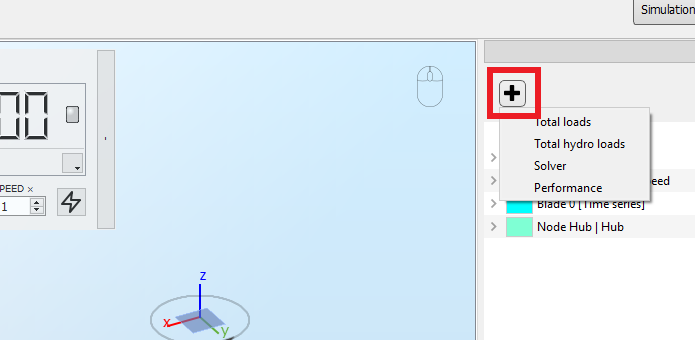
The
Total loads
sensor provides the following fields:
| Field | Unit | Description |
| Hydro perp. drag | N | Sum of the hydrodynamic drag forces acting perpendicular to the relevant member axis, over all selected elements |
| Hydro perp. drag (mag.) | N | Magnitude of the vector sum of the hydrodynamic perpendicular-drag forces over all selected elements |
| Hydro perp. inertia | N | Sum of the hydrodynamic inertia forces acting perpendicular to the relevant member axis, over all selected elements |
| Hydro perp. inertia (mag.) | N | Magnitude of the vector sum of the hydrodynamic perpendicular-inertia forces over all selected elements |
| Hydro perp. added-mass (pseudo) | N | Sum of the pseudo (relative-acceleration) added-mass forces acting perpendicular to the relevant member axis, over all selected elements |
| Hydro perp. added-mass (pseudo) (mag.) | N | Magnitude of the vector sum of the pseudo added-mass perpendicular forces over all selected elements |
| Heave plate drag loads | N | Sum of the forces corresponding to the drag part of the Morison equation applied on the heave plates |
| Heave plate drag loads (mag.) | N | Magnitude of the vector sum of the heave-plate drag forces |
| Heave plate inertia loads | N | Sum of the forces corresponding to the inertia part of the Morison equation applied on the heave plates |
| Heave plate inertia loads (mag.) | N | Magnitude of the vector sum of the heave-plate inertia forces |
| Heave plate Froude-Krylov loads, positive up | N | Sum of the Froude-Krylov forces on the heave plates, positive upwards |
| Heave plate Froude-Krylov loads, positive up (mag.) | N | Magnitude of the vector sum of the Froude-Krylov forces on the heave plates |
| Buoyancy loads | N | 3-component vector with the sum of the buoyancy forces on the structure |
| Buoyancy loads (mag.) | N | Magnitude of the vector sum of the buoyancy forces |
| Buoyancy springs | N | 3-component vector with the sum of the buoyancy spring forces on the structure |
| Buoyancy springs, positive up | N | magnitude of the buoyancy sprinfs vector |
| Total buoyancy | N | sum of the buoyancy and the buoyancy springs |
| Seabed stiffness loads | N | Sum of the loads due to the stiffness of the seabed (see the soil properties) |
| Seabed stiffness loads (mag.) | N | Magnitude of the vector sum of the seabed-stiffness loads |
| Seabed friction loads | N | Sum of the loads due to the friction of the seabed (see the soil properties) |
| Seabed friction loads (mag.) | N | Magnitude of the vector sum of the seabed-friction loads |
| Gravity + buoyancy | N | sum of the buoyancy loads and the loads due to gravity |
| G. + buoy. + seabed stiff. | N | Sum of the loads due to gravity, buoyancy and seabed stiffness |
| Potential flow + drag | N | Sum of the potential-flow loads and the drag loads, over all selected elements |
| Potential flow + drag (mag.) | N | Magnitude of the vector sum of the potential-flow and drag loads |
Note: by default, only the hydrodynamic forces acting perpendiculary to the element axis are calculated with the Morison equation on regular elements. To obtain loads in the axial direction as well, the element must include
Heave plate drag and inertia coefficients (see the
Cross sections keyword in the
Keywords section)