Static pull OpenSees
This validation test compares dynamic simulation results between Ashes and OpenSees for a cantilever beam subjected to a time-varying force at the top. The test validates the structural dynamics solver, including displacement, velocity, and acceleration responses, as well as internal loads.
1 Test Description
The test model consists of a cantilever beam fixed at the bottom and free at the top. The beam represents a simplified tower structure with the following properties:
Geometry:
- Length: 100 m
- Cross-section: Circular hollow section
- Outer diameter: 4 m
- Wall thickness: 30 mm
- Discretization: 10 elements
Material properties:
The model is shown in the image below:
- Young's modulus: E = 210 GPa
- Density: ρ = 8500 kg/m³
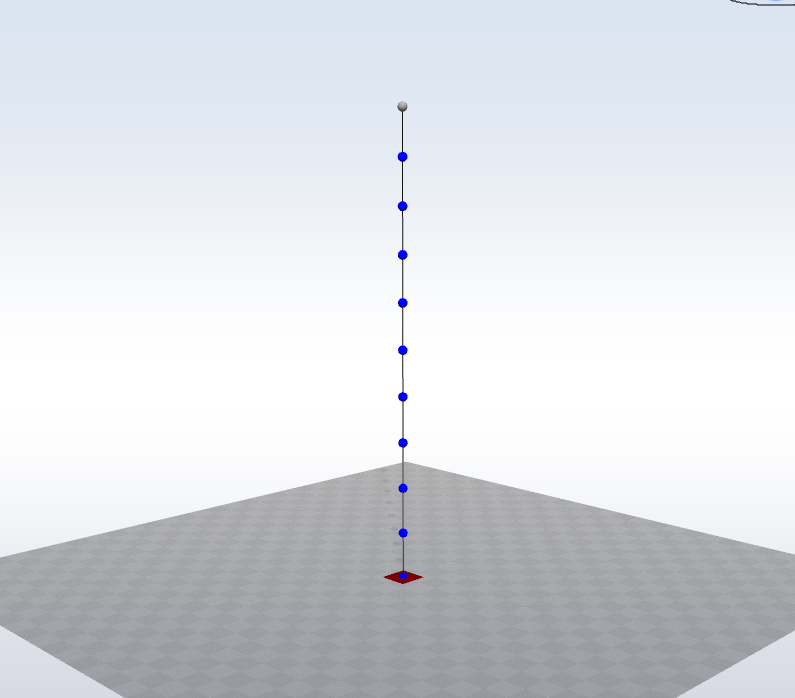
Loading:
A force is gradually applied at the top of the beam and then released after 30 seconds. The total simulation duration is 60 seconds, allowing observation of both the forced response and free vibration decay.
Load cases:
Eight load cases are simulated to test different damping configurations and mass conditions:
Without top mass:
- No damping
- Stiffness proportional damping
- Mass proportional damping
- Rayleigh damping (combined stiffness and mass proportional)
With 150 t top mass:
- No damping
- Stiffness proportional damping
- Mass proportional damping
- Rayleigh damping (combined stiffness and mass proportional)
The different types of damping are including in the model according to the implementation described in the
Rayleigh damping
document.
The simulation is performed using a linear analysis without numerical damping to ensure a pure comparison of the structural dynamics solvers.
2 Comparison Metrics
The following quantities are compared between Ashes and OpenSees:
At the top of the beam (free end):
- Displacement in 6 degrees of freedom (DOFs)
- Velocity in 6 DOFs
- Acceleration in 6 DOFs
At the bottom of the beam (fixed end):
- Internal loads (forces and moments) in 6 DOFs
The simulation results from Ashes are compared with OpenSees for all eight load cases. Time histories of displacements, velocities, accelerations, and internal loads are analyzed throughout the 60-second simulation period.
The differences are quantified using relative errors calculated as:
$$\text{Error} = \frac{|\text{Ashes} - \text{OpenSees}|}{|\text{OpenSees}|} \times 100\%$$
3 Results
The test is considered passed if the results from Ashes are within the following tolerances compared to OpenSees:
- Load cases with proportional damping (cases 2, 4, 6,, 8): Maximum 5% relative error
- Load cases without damping (cases 1, 3, 5, 7): Maximum 20% relative error
The more relaxed tolerance for undamped cases is justified because without proportional damping, high-frequency modes are not damped out. Small discrepancies in the numerical time integration schemes between the two solvers can lead to visible differences in the response, particularly for accelerations. These differences do not indicate errors in either solver but rather reflect the sensitivity of undamped systems to numerical implementation details.
In contrast, when proportional damping is applied, high-frequency oscillations are attenuated, making the comparison more robust and allowing for tighter tolerance requirements.
The comparison between Ashes and OpenSees can be viewed on this link:
https://www.simis.io/downloads/open/benchmarks/current/Static pull Opensees.pdf
https://www.simis.io/downloads/open/benchmarks/current/Static pull Opensees.pdf