Potential Flow Multiple Bodies OpenFAST Loads
This validation test compares wave excitation loads on a semisubmersible floater between Ashes and OpenFAST. The test focuses on the potential flow incident wave loads calculated from WAMIT coefficients for a multi-body system.
1 Test Description
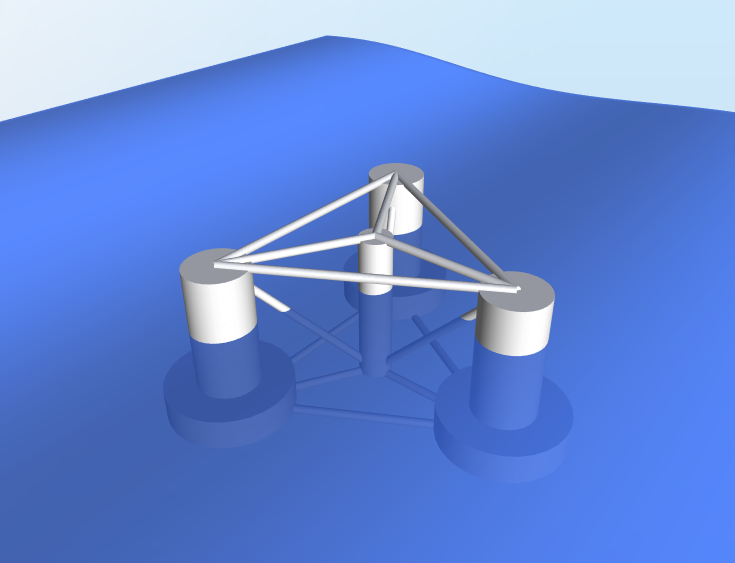
The test simulates a semisubmersible floater subjected to wave excitation forces. The simulations are run in loads-only mode, meaning the floater is held fixed in space and does not move. This configuration isolates the wave excitation forces and excludes radiation damping and added mass forces from the comparison.
The hydrodynamic model uses a WAMIT .3 file containing wave excitation coefficients for each of the three columns of the semisubmersible separately, as well as their hydrodynamic interaction effects. This multi-body approach accounts for the diffraction and radiation interactions between the individual columns.
The model is shown in the image below:
Two load cases are simulated to validate the wave excitation loads:
Load Case 1: Regular Waves
- Wave height: 5 m
- Wave period: 9.67 s
Load Case 2: Irregular Waves
- Wave spectrum: JONSWAP
- Significant wave height: 6 m
- Peak period: 10 s
- Spectral peakedness parameter (γ): 3.3
2 Theoretical Background
When multiple bodies are present in close proximity, such as the three columns of a semisubmersible platform, the wave field around each body is affected by the presence of the others through hydrodynamic interaction effects. In potential flow theory, incident waves are diffracted by each body, creating scattered wave fields that interact with neighboring bodies.
This is accounted for in Ashes following the theoretical backgroun described in the
Potential flow theory document.
3 Results
The validation compares the wave excitation loads computed by Ashes against those from OpenFAST.
The test is considered passed if the Ashes time series values during the last fifth of the simulation (final 24 seconds) are within 10% of the corresponding OpenFAST values. This criterion is applied to all six degrees of freedom for both load cases and all three columns.