Opensees nonlinear material one element
1 Test description
This test analyses the static response of a one-element cantilever beam featuring a nonlinear steel material (Giuffré-Menegotto-Pinto / Steel02) subjected to a transverse tip force of increasing magnitude. Results produced by
OpenSees 3.7.1
are used to benchmark Ashes.
The purpose of the test is to validate the
BilinearGMP material model in Ashes against an equivalent SDOF Steel02 spring formulation in OpenSees. The benchmark covers the elastic range, the elastic-to-plastic transition, and the post-yield hardening regime by sweeping the tip force from 0 to 1 MN in 50 kN increments (21 load cases).
2 Model
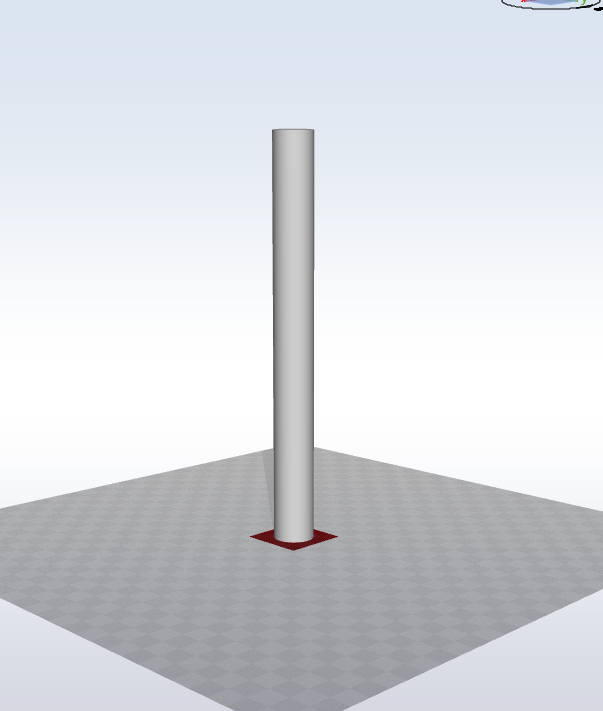
The model is a vertical cantilever beam built with the
Tubular tower only template. The tower is 10 m tall, fixed at the base and free at the tip, and is discretized with a single
PlasticHinge beam element. A point mass of 100 t is placed at the tip node but plays no dynamic role since the analysis is essentially a quasi-static pull.
The cross section is circular hollow with diameter
$$D=1.0\text{ m}$$
and thickness
$$t=0.025\text{ m}$$
.
The material is a
BilinearGMP nonlinear steel matching the parameters of the OpenSees
Steel02 uniaxial material:
$$E=2.1\cdot10^{11}\text{ Pa},\quad \nu=0.3,\quad f_y=2.5\cdot10^{8}\text{ Pa}$$
$$b=0.015,\quad R_0=18,\quad cR_1=0.9,\quad cR_2=0.15$$
where
$$b$$
is the strain-hardening ratio and
$$R_0,\, cR_1,\, cR_2$$
control the curvature of the elastic-to-plastic transition.
Gravity, aerodynamic and wave loads are disabled. A stiffness-proportional damping with
$$\beta_K=0.05\text{ s/rad}$$
is applied to suppress numerical oscillation as the tip force is ramped up. The analysis uses a timestep of 0.02 s with a linear ramp-up of the tip load over 2 s. The Ashes geometric formulation is linear; the only source of nonlinearity in this test is the material.
A tip force in the global x-direction is prescribed at the free node. The test consists of 21 load cases where the tip force takes the values:
$$F_i = (i-1)\cdot 50\text{ kN},\quad i=1,\dots,21$$
i.e. from 0 N (Load case 1) up to 1 MN (Load case 21).
3 Benchmarked solution
The reference solution is computed with OpenSees 3.7.1 using a SDOF formulation that collapses the bending response of the cantilever onto a single uniaxial Steel02 spring at the tip. The flexural stiffness and yield force of the equivalent spring are derived from the cross section and beam geometry:
$$k = \frac{3EI}{H^3},\qquad F_y = \frac{f_y \cdot Z_p}{H}$$
where
$$I$$
is the second moment of area of the hollow circular section,
$$Z_p$$
is its plastic section modulus and
$$H=10\text{ m}$$
is the cantilever length.
The OpenSees model is a one-element
zeroLength spring with a
Steel02 uniaxial material whose parameters
(E, fy, b, R0, cR1, cR2) match the BilinearGMP material used in Ashes. The tip force is applied monotonically with a
LoadControl integrator in 300 increments, and the final tip displacement is recorded. For each load case, the reference value used in the Ashes comparison is the converged static tip displacement returned by the OpenSees pull.
4 Results
For each load case, the global x-displacement of the tip node (Tubular tower RNA node) is compared between Ashes and OpenSees. The test is considered passed if, over the last fifth of the simulated time series (i.e. once the ramp-up is finished and the response has settled), the relative error between the Ashes tip displacement and the OpenSees reference displacement stays below
2%.
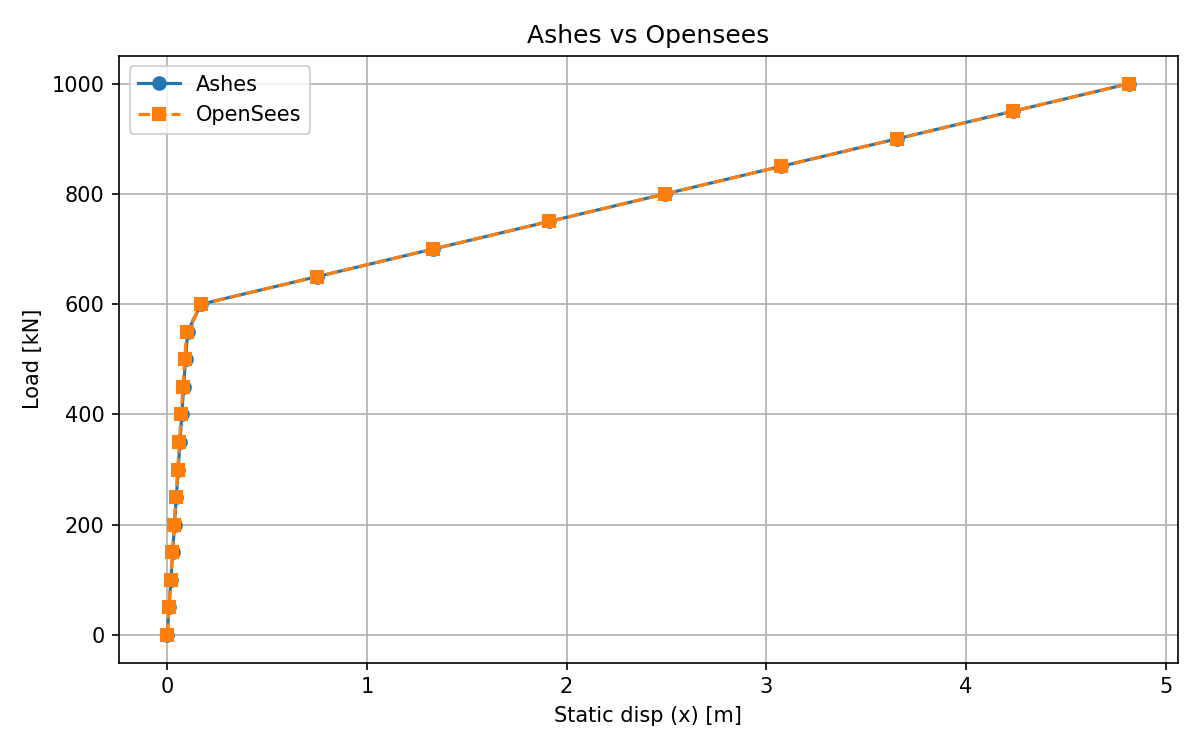
The same acceptance criterion is used for all 21 load cases, which together cover the purely elastic response, the elastic-to-plastic transition around
$$F_y$$
, and the post-yield hardening branch.
The figure below shows the force vs. tip-displacement curve obtained from Ashes and OpenSees over the 21 load cases. The two curves overlap to within the test threshold, capturing the elastic branch, the knee at first yield and the linear hardening branch.
The report for this test can be found on the following link: